The S-1 filing record is the most granular forward-looking signal in public equity markets.
Before a company lists, before it prices, it files. The aggregate of those filings, read thematically, describes what the economy is producing: which sectors generate consistent listing supply regardless of the rate environment, which convert registrations into actual listings at high rates, and which new directions are already building the companies that will define the next cycle.
Between 2020 and 2022, that signal was distorted by volume. Special Purpose Acquisition Companies dominated the US filing record. At peak, they outnumbered Health, Software, and every other operating-business sector by company count. By 2023, SPAC volumes had collapsed and many vehicles wound down without completing a deal. What remained was a cleaner pipeline: operating businesses with defined investment theses, filing when their science or their market forced it. Figure 1 makes that transition legible: SPAC volumes define 2020–2022 and then fall away, leaving operating-business themes to fill the register.
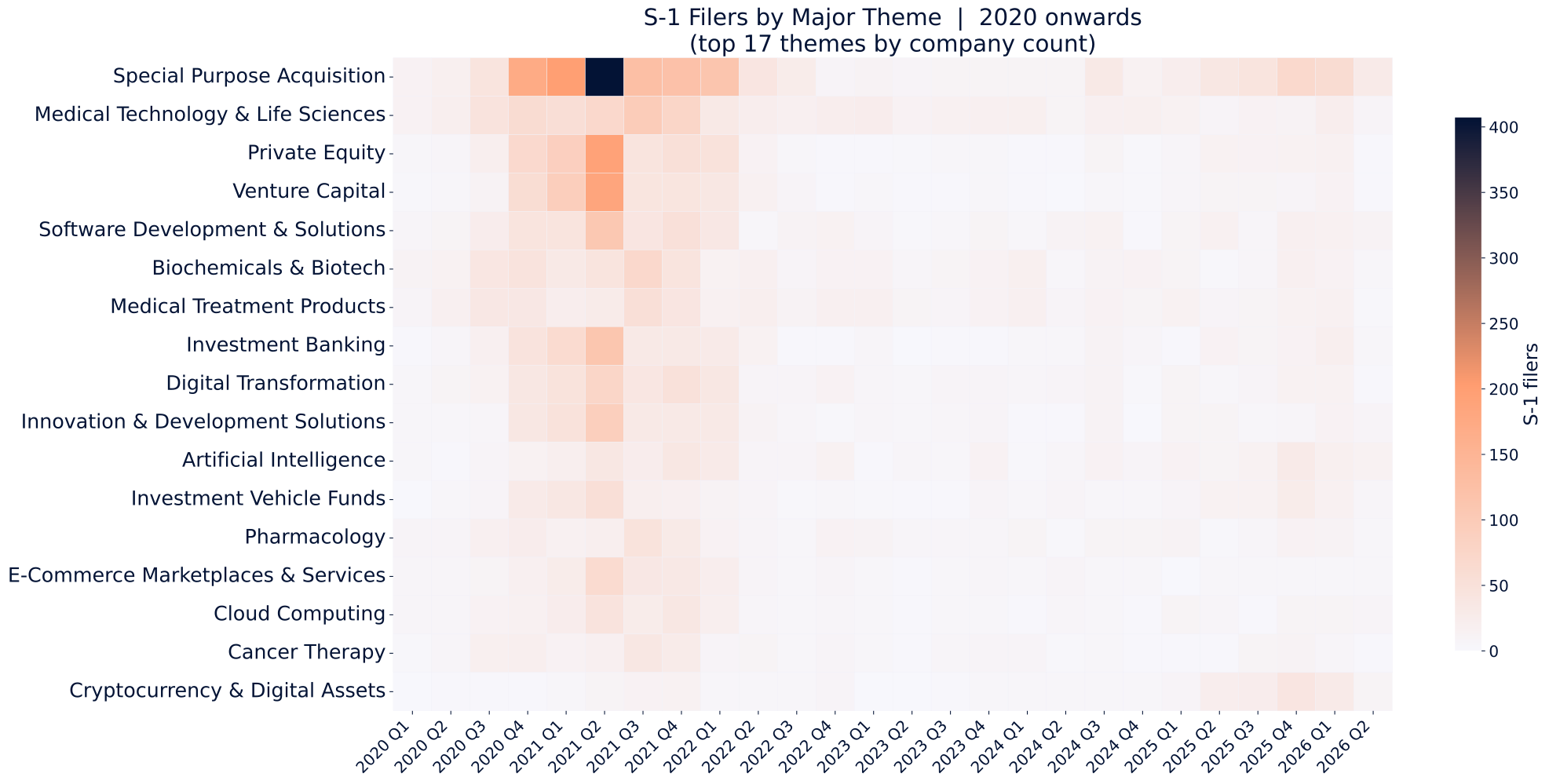
Figure 1: S-1 filers by major theme. SPACs dominate 2020–2022, distorting any thematic read of that period.
TIIC covers more than 9,000 S-1 registrations across its full universe. The pre-2022 Q2 window is excluded for the reason Figure 1 makes visible: SPAC activity at that scale swamps every operating-business theme. The analysis that follows focuses on filings since 2022 Q2, reading them by investment theme rather than deal size, geography, or sector label, to surface what aggregate data does not: the structural backbone of the current listing pipeline, which themes within it have actually converted to listings, and where the economy's next wave is already taking shape. Each filing is anchored to the nearest TIIC quarterly reference date (1 February, 1 May, 1 August, or 1 November).
The Stable Layer: Themes That Persist Across Cycles
Filing frequency separates structural supply from sentiment-driven noise. To make that distinction precise, we count how often each major theme appears in the top 10 by S-1 company count, quarter by quarter, since 2022 Q2 (see Figure 2).
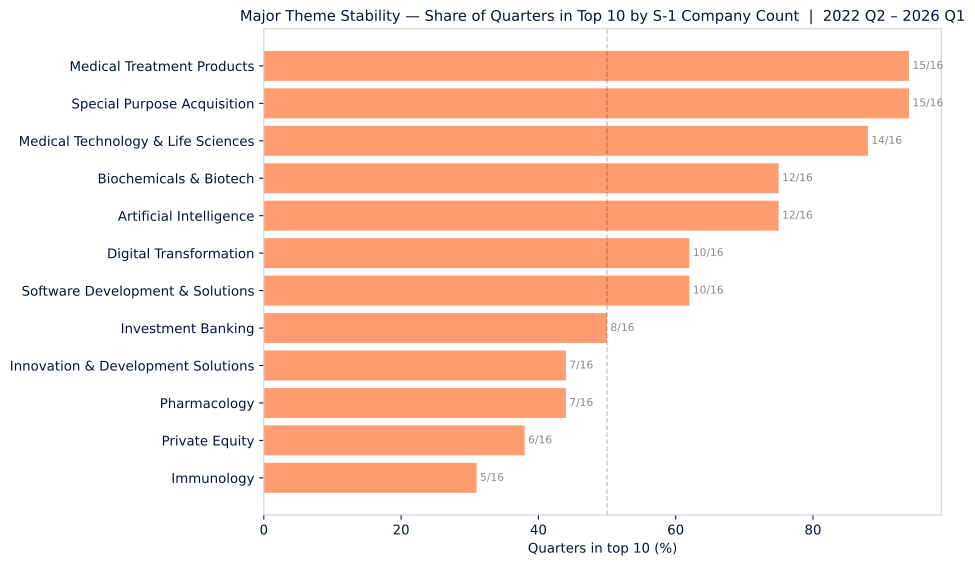
Figure 2: Theme stability — share of quarters in top 10. Health and AI are structural fixtures; most other themes are cyclical or episodic.
Medical Treatment Products appears in the top 10 in 15 of 16 quarters; Medical Technology & Life Sciences in 14. Biochemicals & Biotech and Artificial Intelligence follow, each present in 12. These four form the structural core of the S-1 pipeline: Health because clinical development timelines are largely independent of macro conditions (companies file when the science forces it, not when the rate environment invites it); AI because the infrastructure and application layer buildout has been continuous, generating listings across GPU cloud, vertical software, and clinical AI simultaneously. Software Development & Solutions and Digital Transformation are present in 62% of quarters, consistent but cyclically sensitive. Special Purpose Acquisition is present in 15 of 16 quarters, level with Medical Treatment Products. The 2020–2021 surge was the anomaly; blank-cheque vehicle formation continued after the unwind, recalibrating to lower but steady volumes that run on sponsor timelines independent of sector conditions or macro sentiment.
Other themes tell a different story: concentrated bursts of activity in specific quarters, with little presence before or after. The 2022 Q4 spike in Optical Communications & Optoelectronics brought a cluster of telecom and utility infrastructure businesses onto the register: electrical construction, wireline services, field logistics, and satellite installation. The same quarter's spike in Non-Solar Renewable Energy overlapped with this group and added a set of genuine renewable energy filers: OPAL Fuels (renewable natural gas, SPAC-backed by NextEra), Beacon RNG (landfill gas-to-RNG), BioPower Operations (biogas), and Green Energy Global (clean energy products). Commercial Facilities in 2023 Q4 produced a more eclectic group: Atlanta Braves Holdings (MLB franchise and mixed-use real estate), Box PureAir (air purification for schools), Digital Locations (5G cell tower sites), EV Mobility and Energy Wyze (EV charging and solar lead generation), Frontline Power Solutions (retail energy supply), and RenX Enterprises (modular housing). A varied set with no single thematic catalyst; the theme quieted as quickly as it had appeared.
Who Actually Listed
Filing frequency measures pipeline supply; it does not determine what actually lists. Across all S-1 filers in the TIIC universe since 2022 Q2, Special Purpose Acquisition produces the highest count of currently public companies, a structural outcome of the SPAC format itself where completing a business combination by definition creates a listed entity. Among operating businesses, Medical Technology & Life Sciences leads at 206 companies, followed by Medical Treatment Products (151), Biochemicals & Biotech (144), and Artificial Intelligence (137). Health themes occupy three of the top four positions, a function of both volume and persistence. The remainder of the top 10 by public company count is Software Development & Solutions (112), Digital Transformation (105), Private Equity (100), Pharmacology (100), and Investment Banking (88): enterprise technology and financial services generating steady listing supply alongside the dominant Health block.
At micro theme level, Clinical Trial Services leads at 113, followed by Biopharmaceuticals (91) and AI Platforms (88). The AI micro theme cluster (AI Platforms, Machine Learning Platforms at 72, Algorithms at 66, AI Model Training & Deployment at 46) reflects the range of what has come to market under the AI banner: infrastructure players, model developers, and application-layer businesses sitting under the same major theme.
An S-1 puts a company on the runway. It does not get them off the ground. The conversion rate, measured as the share of S-1 filers per major theme that are currently public, surfaces further differences. Figure 3 reads rate and volume together: the bar shows the public/private split, the number beside it the size of the filer pool.
The leaders combine volume and conversion: Immunology at 80.6% across 93 filers, Cancer Therapy at 78.1% across 105, Artificial Intelligence at 76.5% across 179. Some themes file at scale but rarely list: Stock Exchanges & Trading Platforms converts at 15.2% across 99 filers, Investment Vehicle Funds at 23.1% across 134. High volume and low conversion here reflects regulatory-driven filings or deals pulled before they price.
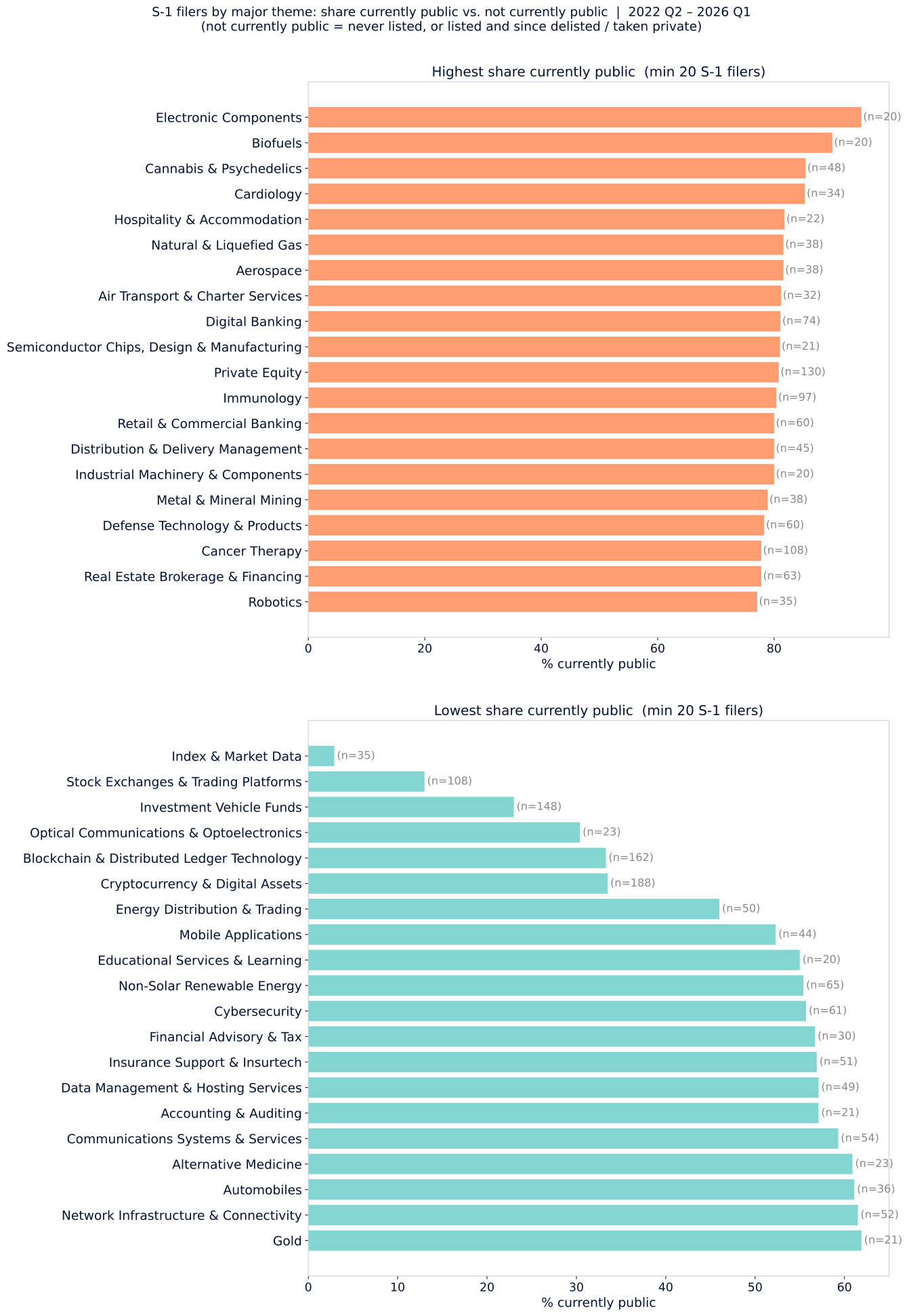
Figure 3: S-1 filers by theme — hit rate and filer pool. Health and AI lead on both dimensions; financial and digital asset themes file heavily but rarely list.
Emerging Themes at the Frontier
New sectors form before they get named. The economy's most recent structural shifts in AI infrastructure, edge computing embedded in physical industries, and the small-modular turn in nuclear energy are already generating S-1 filings. As these shifts become distinct enough to classify, the companies operating within them are already approaching public markets.
Large Language Models & Generative AI, introduced at the February 2025 reference date, already has 10 S-1 filers mapped against it, 6 currently public and 4 still private, including CoreWeave (GPU cloud infrastructure) and Figma (collaborative design platform). Cryptocurrency Staking, added at the February 2026 reference date, has 7 filers, all currently public. Colocation Data Centre Infrastructure & Services follows with 5 filers (4 public, 1 private). Humanoid Robots carries 3 filers, all now publicly listed. Inference Computing & Services, introduced only at the February 2026 reference date, has 3 filers, none of which has yet listed.
Motive Technologies is one of them: an Alphabet-backed fleet intelligence platform that filed its S-1 in December 2025, deploying AI dashcams that run real-time collision-detection models directly on the vehicle. Its TIIC exposure spans Inference Computing & Services (AI executing at the edge, on-device), Data Annotation Platforms & Tools (labelling dashcam footage to train the underlying vision models), and Driver Training (AI-assisted coaching that scores driver behaviour from the same camera feed). This is a single business touching multiple newly classified niches because the product itself bridges them. Figures 4 and 5 map its full TIIC classification by major and micro theme; weight reflects each theme's share of the company's total TIIC exposure at that level (major or micro).
Figure 4: Motive Technologies' major theme exposure. Artificial Intelligence carries the largest share, anchoring a business that runs AI at the edge of physical operations.
Figure 5: Motive Technologies' micro theme exposure. A single business spans thirteen distinct niches.
At micro theme level, no single niche dominates: the largest weight, AI Platforms at 13%, sits just two percentage points above the third-ranked theme. The three themes named above — Inference Computing & Services, Data Annotation Platforms & Tools, and Driver Training — account for 20% combined; while the remaining micro themes range between 4% and 12% each.
Small Modular Nuclear Reactors, also added in February 2026, already has 2 public companies behind it. Figure 6 collects these emerging micro themes side-by-side; the public/private split makes the early-stage character of the cohort visible at a glance.
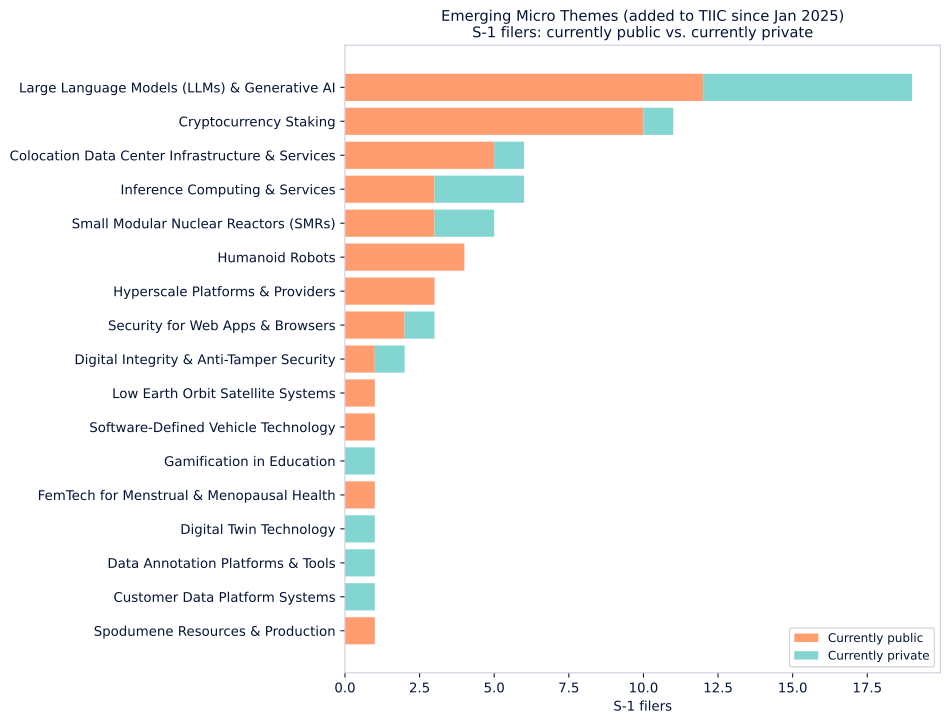
Figure 6: Emerging micro themes — S-1 filers by current status. Small filing counts signal early-stage sectors, not marginal ones.
The sectors in Figure 6 did not exist as classified investment themes two years ago. The companies now filing within them are building, raising capital, and approaching public markets while their categories are still forming. A thematic lens that keeps pace with the economy surfaces them here — while they are still filing, not yet listed, and before they become standard coverage.
What the Data Shows
The S-1 record, read thematically, tells a consistent story across 16 quarters. Health, spanning clinical development, biopharmaceuticals, and medical technology, is the structural backbone of the operating-business pipeline, present in nearly every quarter and producing the highest count of listed companies. AI has moved from a cyclical theme to a permanent feature: 12 of the last 16 quarters in the top 10, converting above 75%, with companies spanning the full stack from GPU infrastructure to clinical applications. SPACs remain a steady fixture; the 2021 peak was the anomaly, not a baseline that subsequently collapsed. And the economy's newest directions, from inference computing and humanoid robotics to modular nuclear and GPU cloud, are already in the filing record in sectors that barely had names a year ago.
The companies that will define the next listing cycle are already filing. The question is whether you can read the record before they list.
For access to the full TIIC dataset or to discuss thematic coverage of the IPO pipeline, please contact us.
Get in Touch
press@theiainsights.comAbout Theia Insights
Theia Insights is a deeptech company building the common ontology for global financial markets. Founded in Cambridge, Theia combines proprietary AI, natural language processing, quantitative modelling and knowledge graph architecture to translate diverse sources of corporate and financial signals into a living map of the economy.
Used by leading index providers, asset managers, hedge funds, banks and fintech platforms, Theia's structural intelligence layer enables consistent, auditable and economically grounded decision-making across teams, systems and increasingly, AI workflows.
Named after the Greek goddess of sight, Theia reflects its mission: to make visible the underlying structure of the global economy.